
Have you ever doubted why some tracks sound flat even through premium headphones, while others give you chills from the first note?
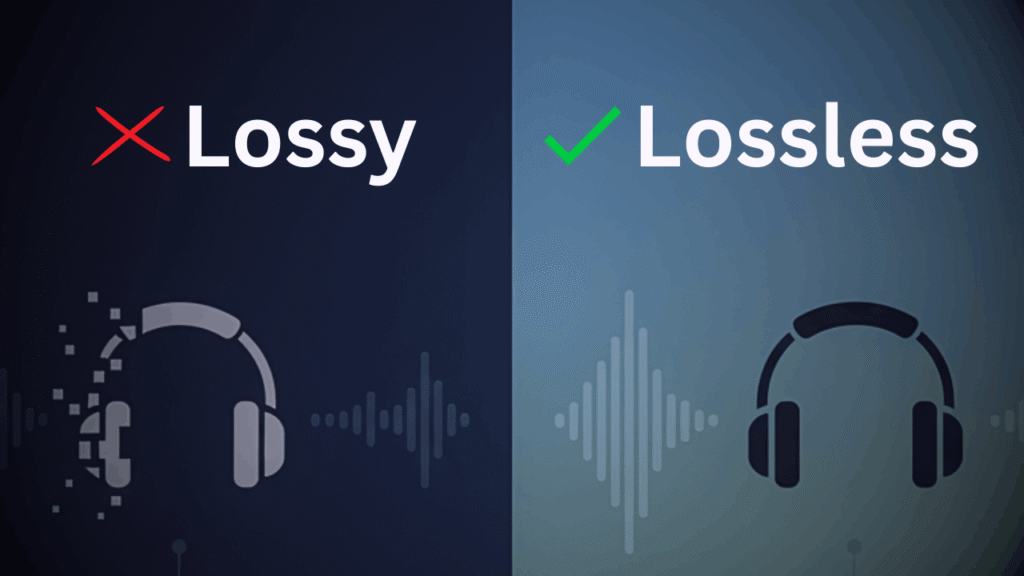
As audio gear improves and our ears become more demanding, the debate around Lossy vs. Lossless Audio has become one of the most intriguing questions for music lovers today.
Choosing the wrong format can quietly strip away detail or waste precious storage, while the right choice can transform how you connect with music. Streaming, downloads, codecs, bitrates, there’s a lot of noise around the topic.
This guide cuts through the hype to explain what really matters, when quality differences are audible, and which option actually fits your listening habits. Stay with us!

What Is Lossless Audio Format?
At the heart of the Lossy vs. Lossless Audio discussion lies a simple promise: preserving sound exactly as it was recorded.
A lossless format stores every bit of musical information without permanently discarding data, which means what reaches your ears is mathematically identical to the studio master. This is why lossless audio is often described as “bit-perfect,” especially valued by listeners who want transparency, depth, and nuance across complex recordings.
From an engineering perspective, this approach relies on reversible audio compression, where data is reduced for storage efficiency but can be fully reconstructed during playback.
Nothing is guessed, approximated, or removed forever. The result is a listening experience where micro-details, room ambience, subtle reverb tails, and delicate instrument textures remain intact. Lossless formats are commonly used in professional production, archiving, and serious home listening environments because they protect long-term sound integrity.
They also provide a dependable reference point for evaluating playback equipment, since the source itself introduces no degradation. In the broader Lossless vs. Lossy Audio conversation, lossless formats represent accuracy, consistency, and trust in the original recording.

What Is a Lossy Audio Format?
On the other side of the Lossy vs. Lossless Audio spectrum is a philosophy built around practicality and speed. A lossy format reduces data by permanently removing parts of the signal that are considered less noticeable to the human ear. This process creates much smaller files, making lossy audio ideal for everyday listening scenarios where convenience matters more than forensic accuracy.
The reduction works by applying psychoacoustic principles, guided by sophisticated compression algorithms that predict which sounds are likely to be masked by others. Once removed, that data cannot be restored, even if the file is converted later. While this might sound severe, modern encoding techniques have become extremely effective, especially at higher settings.
For many listeners, lossy formats strike a comfortable balance between accessibility and enjoyment. They load quickly, sync easily across devices, and perform well in mobile and streaming environments.
In the ongoing Lossless vs. Lossy Audio discussion, lossy formats represent efficiency, portability, and scalability, qualities that explain their dominance in mainstream consumption.

What Is the Difference Between Lossless and Lossy Formats?
The real distinction in Lossy vs. Lossless Audio becomes clear when you examine how sound data is treated and what that means for real-world listening. At a technical level, the difference isn’t just about quality; it’s about intent, use case, and trade-offs.
Lossless formats preserve the full signal, while lossy formats selectively remove data to reduce storage demands. This impacts bitrate, which measures how much audio information is processed per second.
Higher values generally allow for more detail, though perception depends on equipment and environment. In a controlled sound quality comparison, trained listeners may notice differences in clarity, spatial cues, or dynamic range, while casual listening may reveal little contrast at all.
The debate is often framed through familiar examples like MP3 vs FLAC, but the broader ecosystem of digital audio formats offers many options tailored to different needs. Below is a simplified comparison to clarify the core contrasts in the Lossy vs. Lossless Audio discussion:
| Aspect | Lossless Formats | Lossy Formats |
| Data retention | 100% preserved | Selectively removed |
| File size | Larger | Smaller |
| Editing & archiving | Ideal | Not recommended |
| Listening focus | Accuracy and detail | Convenience and speed |
| Typical use | Studio, home hi-fi | Mobile, streaming |
Ultimately, the difference comes down to priorities. If your goal is maximum audio fidelity, lossless formats provide a transparent window into the recording. If flexibility matters more, lossy formats offer efficiency without severe compromise.
Choosing Between Lossless and Lossy
Deciding between formats in the Lossy vs. Lossless Audio conversation depends less on theory and more on context. Your listening habits, equipment, and distribution method all play a role. For example, streaming audio quality varies widely depending on platform settings, network conditions, and playback devices.
In many cases, the listening environment itself introduces more limitations than the format choice.
Storage and bandwidth also factor into the classic dilemma of file size vs quality. Large libraries, mobile data caps, and limited device memory often favor smaller files, while dedicated listening setups can easily accommodate larger ones.
Compatibility matters too, as some ecosystems support specific containers like “WAV, AAC, ALAC”, each designed with different balances of openness, efficiency, and system integration.
If you own resolving headphones or speakers and enjoy focused listening sessions, exploring high-resolution audio can be rewarding, especially when paired with lossless sources. On the other hand, for commuting, workouts, or background listening, the practical advantages of lossy formats often outweigh subtle sonic gains.
In the end, Lossless vs. Lossy Audio is not about choosing a winner; it’s about choosing what fits your lifestyle. Many listeners even mix both approaches, reserving lossless files for favorite albums and relying on lossy versions elsewhere.
Wrapping up
The debate around Lossy vs. Lossless Audio isn’t a matter of right or wrong, but of intention and awareness. Lossless formats offer precision, longevity, and confidence in the source, while lossy formats deliver speed, efficiency, and accessibility.
Understanding how each works empowers you to make choices that align with how, where, and why you listen. Rather than chasing specifications for their own sake, the smartest approach is informed flexibility.
Now it’s your turn; Which format do you personally prefer, and why? Have you ever noticed a difference when switching formats? Where do you listen most, on the go or in a dedicated setup?