
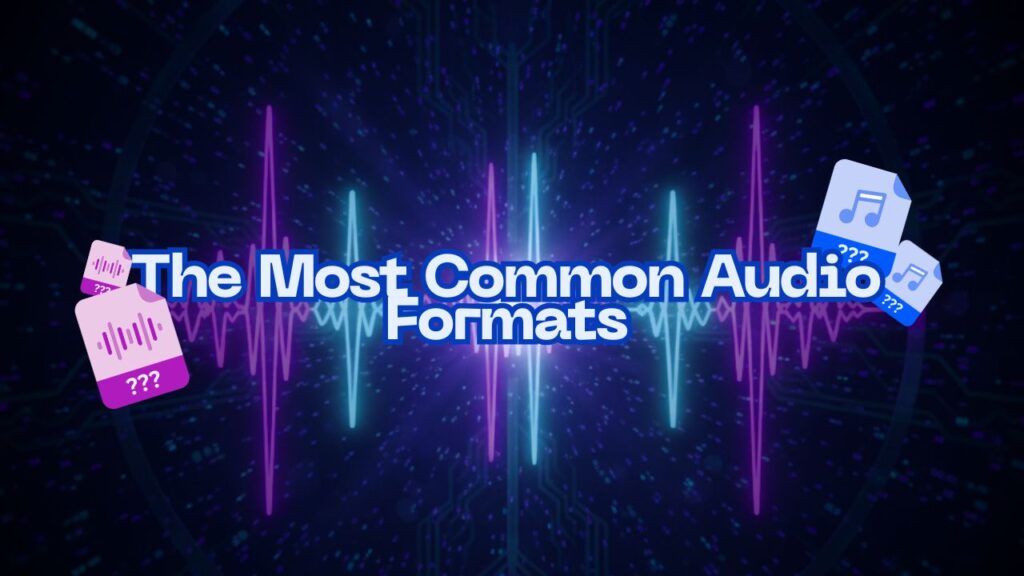
Ever doubted why some songs feel like they come alive, while others sound flat, no matter how loud you play them? The secret often lies in “Audio Formats, the invisible blueprint that shapes every note, beat, and vocal you hear.

From MP3s that fit thousands of tracks in your pocket to FLAC files that deliver studio-perfect clarity, choosing the right format can completely change your listening experience.
Whether you’re a casual listener, a streamer, or an aspiring producer, understanding these formats unlocks the hidden power of your music. Dive in and discover which ones make your tracks truly shine!
Top 10 Audio File Formats Explained
Choosing the right audio formats is crucial for how music is stored, shared, and ultimately experienced.
With the growth of streaming platforms, high-resolution audio, mobile devices, and professional production, understanding the differences between digital music formats ensures you balance file size, device compatibility, and optimal sound quality.
This guide explores the ten most relevant formats today, explaining where each excels, its technical characteristics, and its practical use in the modern audio landscape.

- MP3
The MP3 audio format is the most widely recognized and supported audio file in the world. It achieves significant compression by removing audio data that is less perceivable to human ears, making it ideal for portable devices, fast downloads, and everyday listening. MP3 files are highly compatible with nearly every device and media player, from computers and smartphones to car stereos. While the compression reduces file size, it slightly sacrifices sound quality, making it a classic example of lossy audio. Despite its age, MP3 remains popular due to its simplicity and universality.

- AAC
Advanced Audio Coding (AAC) was developed as a successor to MP3 to provide better efficiency and improved fidelity at similar file sizes. Comparing AAC vs MP3, AAC generally performs better at the same bitrate, producing clearer vocals and richer instrumentals. It is widely used in streaming services, mobile platforms, and digital radio because it balances audio compression with high sound quality. AAC is also the standard for digital music formats in Apple’s ecosystem, supporting seamless integration with iTunes, Apple Music, and iOS devices.

- WAV
WAV audio formats are uncompressed audio, meaning they retain all original data from the recording. This makes them ideal for professional audio production, mixing, and broadcasting. When comparing WAV vs FLAC, WAV offers complete fidelity but requires significantly more storage, while FLAC reduces file size without any data loss. WAV files provide the highest sound quality for production work, support high bitrates, and are fully compatible with professional DAWs and audio interfaces.

- FLAC
FLAC audio is a lossless audio format that compresses audio without losing any of the original data, making it ideal for archiving music and listening in high fidelity. FLAC files are smaller than WAV files while maintaining perfect reproduction of the source, supporting high-resolution audio playback on compatible devices. This makes FLAC a favorite among audiophiles who want exact copies of recordings while keeping storage requirements reasonable.

- ALAC
Apple Lossless Audio Codec (ALAC) offers similar functionality to FLAC but is optimized for Apple devices. ALAC maintains full lossless audio fidelity, supports high-resolution audio, and integrates seamlessly with macOS, iOS, and Apple Music. It is perfect for users who want the benefits of audio file types that preserve every detail of the music while maintaining compatibility across the Apple ecosystem.

- OGG Vorbis
OGG Vorbis is an open-source, lossy audio format designed to provide high efficiency without licensing fees. It performs well at lower bitrates, delivering excellent sound quality relative to file size, and is commonly used in gaming, open-source projects, and online streaming platforms. Its flexible audio compression allows developers to optimize files for size without sacrificing clarity, making it a practical alternative for developers seeking efficient digital audio formats.

- Opus
Opus is a versatile, modern codec capable of handling both music and voice content. It is highly efficient at low bitrates and supports very low latency, which is crucial for streaming and real-time communication applications. Opus combines adaptive audio compression techniques to maintain sound quality across a wide range of content, making it ideal for VoIP, live streams, and interactive media. Its ability to scale from lossy audio to near-transparent quality at higher bitrates makes it one of the most flexible formats today.

- AIFF
Audio Interchange File Format (AIFF) is Apple’s uncompressed alternative to WAV. AIFF files store every bit of the original recording, supporting professional production with exact sound quality. Commonly used in Mac-based studios, AIFF is a go-to format for recording, editing, and mastering because it preserves high-bitrate data and integrates well with Apple’s software suite. While storage-heavy, it provides the fidelity needed for professional workflows.

- WMA
Windows Media Audio (WMA) was developed by Microsoft to integrate tightly with Windows devices. WMA supports both lossless audio and lossy audio profiles, offering flexibility depending on storage needs. Though less common today, it played a key role in early digital music services and is still relevant for legacy Windows-based systems. WMA audio formats can vary in bitrate, allowing users to choose between high-quality playback and smaller file sizes.

- DSD
Direct Stream Digital (DSD) uses a unique method of encoding audio at extremely high sampling rates, offering high-resolution audio suitable for audiophiles. DSD files are large and require specialized playback hardware, but they provide a listening experience that captures nuances often lost in traditional digital music formats. This format is preferred for archival purposes and premium audio releases where ultimate sound quality is the priority.
Comparison Table: Audio File Formats at a Glance
Understanding technical differences among audio formats can simplify decisions for both casual listeners and professionals. This table summarizes key features, including lossless vs lossy audio, file size, compatibility, and primary use cases.
| Format | Compression Type | File Size | Compatibility | Typical Use Case |
MP3 | Lossy | Small | Universal | Every day listening, portable libraries |
AAC | Lossy | Small | Very High | Streaming, mobile devices, and efficient storage |
| WAV | None | Very Large | High | Recording, editing, mixing |
FLAC | Lossless | Medium | High | Archival, audiophile listening, hi-res audio |
ALAC | Lossless | Medium | Apple devices | Apple ecosystem, high-fidelity playback |
OGG Vorbis | Lossy | Small | Moderate | Games, open-source platforms, streaming |
Opus | Lossy | Very Small | Growing | Voice calls, low-latency streaming |
AIFF | None | Very Large | Apple-focused | Professional editing, mastering |
WMA | Lossy/Lossless | Small–Medium | Windows | Legacy libraries, adjustable bitrate |
DSD | Specialized | Very Large | Limited | Audiophile playback, premium releases |
Conclusion
Understanding modern audio formats equips listeners, creators, and professionals with the knowledge to optimize storage, bitrate, and playback quality. Each format exists to solve specific challenges.
By choosing the right format for the right situation, users can ensure music sounds exactly as intended, while balancing device limitations and personal preferences.
Engage with us; Share which audio format you prefer and why? Have you noticed a real difference between compressed and uncompressed files? Are you building a music library or producing your own content?